Have you ever paused while writing and wondered whether you should use as or like? You’re not alone. Thousands of English learners, students, writers, and even native speakers search every month for “as vs like,” “What is the difference between like and as?” and “Is it like I said or as I said?” because these two small words often seem interchangeable.
Although as and like are both used to make comparisons, they do not always have the same meaning. Using the wrong one can make your sentence sound unnatural or grammatically incorrect, especially in academic writing, business emails, professional documents, and English exams. The confusion becomes even greater because many people use like casually in everyday conversation, while grammar experts usually recommend as in formal writing when a complete clause follows.
This complete guide explains the difference between as and like using simple grammar rules, comparison tables, real-life examples, expert tips, and practice exercises. You’ll also learn how British and American English use these words, discover common mistakes to avoid, understand how like and as work in similes, and find answers to the most common grammar questions. By the end of this article, you’ll know exactly when to use as and when to use like with confidence.
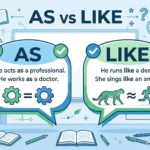
As vs Like
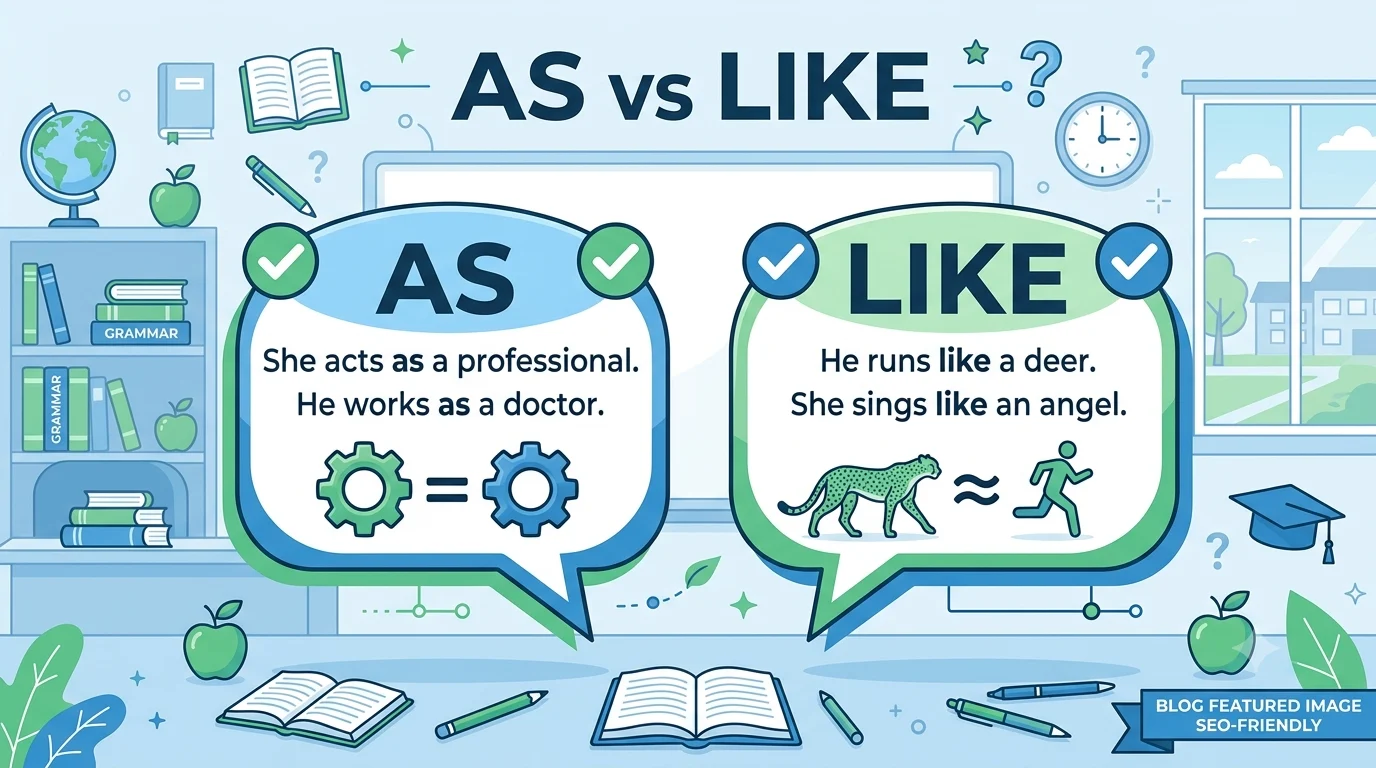
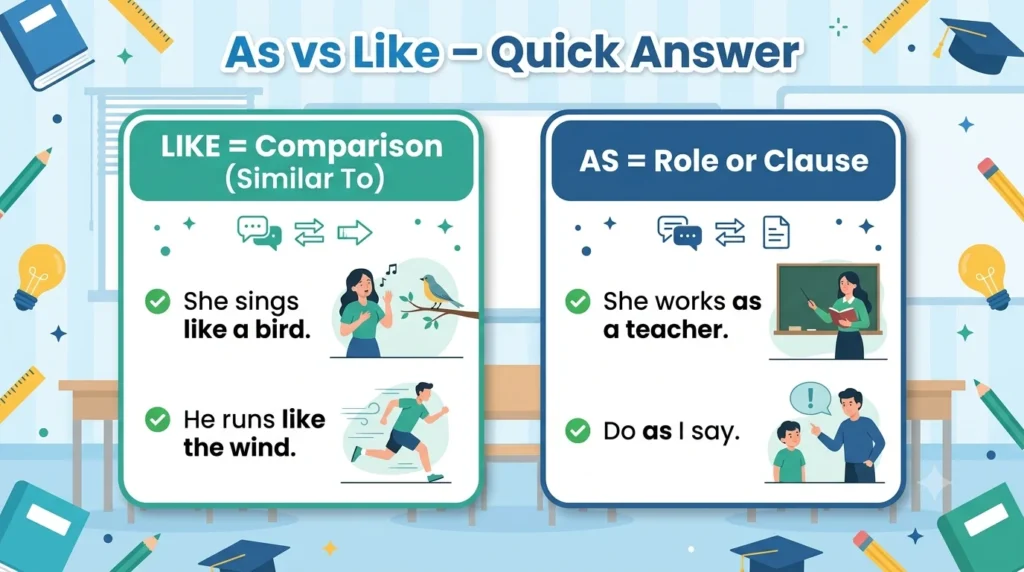
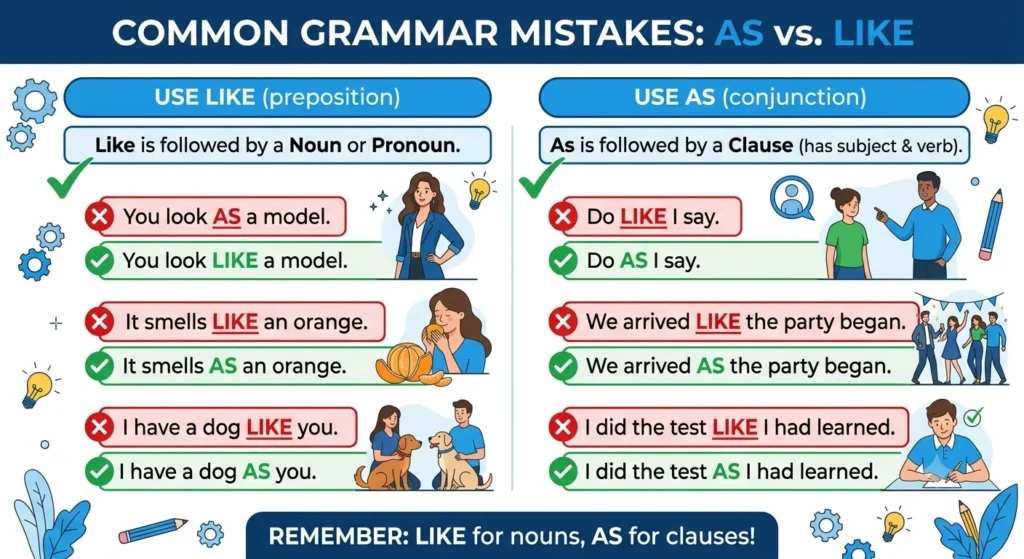
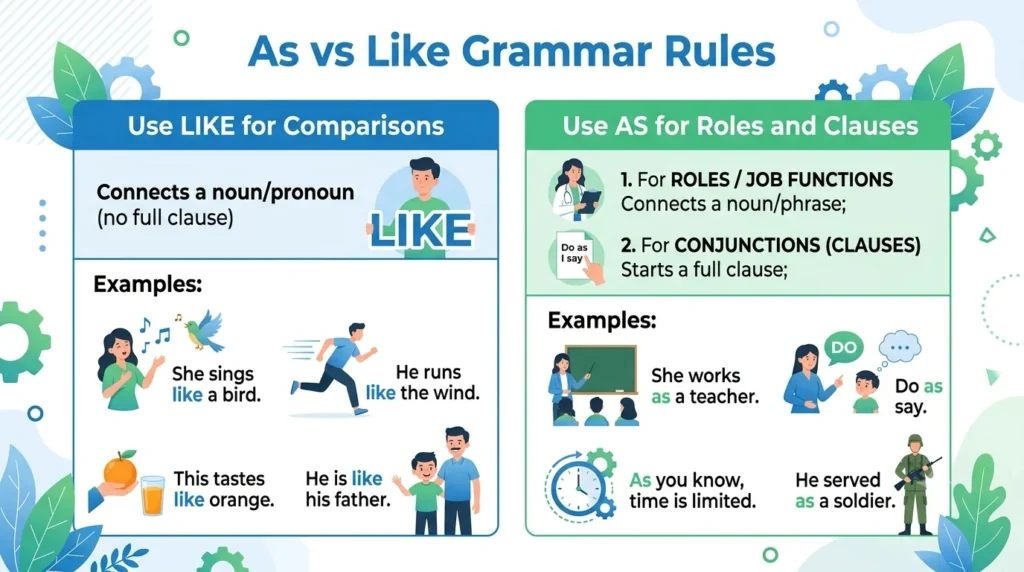
The difference between as and like is simple:
- Like is used to compare people, things, or ideas.
- As is used to describe a person’s role, function, or to introduce a clause with a subject and a verb.
Examples
✅ She sings like a professional.
(She sings similarly to a professional.)
✅ She works as a teacher.
(Teacher is her job.)
✅ Do as I told you.
(A complete clause follows.)
❌ Do like I told you.
(Common in casual speech but not recommended in formal English.)
Key Takeaways
✔ Use like when you mean similar to.
✔ Use as when talking about a role, job, function, or before a complete clause.
✔ Both like and as can appear in similes, but they are used differently in grammar.
✔ In formal writing, as I said is preferred over like I said.
Quick Comparison Table
| Feature | As | Like |
|---|---|---|
| Main use | Role, function, or clause | Comparison or similarity |
| Formal writing | Preferred | Mainly comparisons |
| Casual conversation | Common | Very common |
| Before a clause | ✅ Yes | ❌ Usually avoided |
| Before a noun | Sometimes | ✅ Yes |
The History and Grammar Development of As and Like
Unlike words such as colour/color or recognise/recognize, as and like are not different spellings of the same word. Instead, they are two separate English words with different histories and grammatical functions. Understanding where they came from makes their modern usage much easier to remember.
The Origin of “Like”
The word like comes from the Old English word gelīc, which meant similar, equal, or having the same appearance. For centuries, English speakers have used like to compare people, places, objects, and ideas.
Examples:
- The clouds look like cotton.
- He runs like the wind.
- She smiles like her mother.
In every example, like introduces a comparison.
The Origin of “As”
The word as developed from the Old English expression alswā, meaning in the same way, to the same degree, or while.
Over time, as became one of the most flexible words in English. Today, it can function as:
- a conjunction
- a preposition
- an adverb
Examples:
- She works as a nurse.
- Do as I say.
- As the meeting ended, everyone left.
Unlike like, as often connects ideas rather than simply comparing them.
How Grammar Changed Over Time
In early English, as was commonly used whenever speakers wanted to describe the way something happened.
As English evolved, like became increasingly popular in everyday speech because it sounded shorter and more conversational.
Today:
- Like dominates informal conversation.
- As remains the preferred choice in formal English whenever a complete clause follows.
This explains why native speakers sometimes say:
Like I told you…
while grammar books recommend:
As I told you…
Both expressions are widely understood, but only one is considered standard in formal writing.
Why Do People Confuse As and Like?
Many learners ask:
“What is the difference between like and as?”
The confusion happens because both words can introduce comparisons.
For example:
She sings like Adele.
This compares two singers.
Now compare it with:
She sings as Adele taught her.
Here, as introduces a clause with its own subject and verb.
The meanings are different, even though both sentences involve comparison.
Language Expert Advice
English teachers often recommend learning one simple rule before memorizing exceptions:
- Like = Similar to
- As = In the role of or followed by a complete clause
This single rule correctly explains most real-life situations.
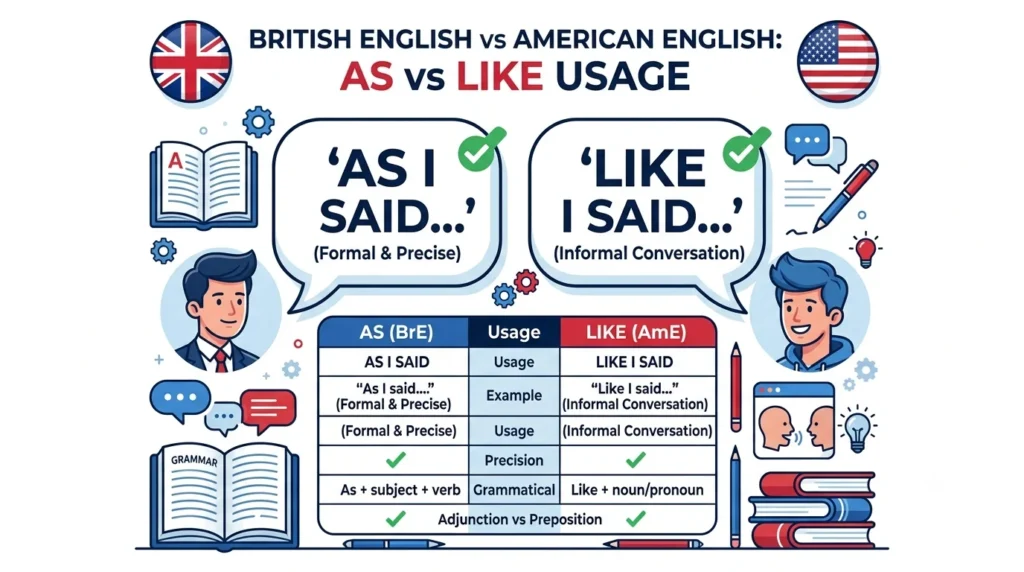
British English vs American English Usage
One of the biggest myths about as vs like is that they have different spellings in British and American English.
They do not.
The spelling is exactly the same worldwide.
The real difference is usage, especially in formal and informal English.
American English
In the United States, many native speakers naturally say:
Like I said yesterday…
This expression is very common in conversation, television shows, podcasts, and social media.
However, American grammar books still recommend:
As I said yesterday…
for academic writing, professional communication, and formal documents.
British English
British English generally follows traditional grammar more closely.
Formal British writing usually prefers:
As I explained earlier…
rather than:
Like I explained earlier…
In casual conversation, however, British speakers also use like frequently, especially in everyday speech.
Formal vs Informal Usage
| Situation | Recommended Choice |
|---|---|
| Academic writing | As |
| Business emails | As |
| School essays | As |
| Newspapers | Mostly As |
| Casual conversations | Like is common |
| Social media | Both appear frequently |
British vs American Comparison Table
| Grammar Situation | American English | British English |
|---|---|---|
| Formal writing | Prefer as | Prefer as |
| Informal conversation | Like is common | Like is common |
| Job or role | As | As |
| Comparing people or things | Like | Like |
| Grammar rule | Same | Same |
Ninth or Nineth: Meaning, Difference, and Correct Usage ✨
Which Should You Use?
Choosing between as and like depends on the grammar of your sentence and the meaning you want to express. Although they can both introduce comparisons, they are not always interchangeable. Learning a few simple rules will help you use them correctly in conversations, emails, essays, exams, and professional writing.
Use “Like” for Comparisons
Use like when comparing one person, thing, or idea to another. In most cases, like means similar to.
Examples
- She sings like a professional singer.
- He runs like the wind.
- The baby sleeps like an angel.
- This cake tastes like chocolate.
- The clouds look like cotton.
In each example, like compares two things.
Easy Rule: If you can replace like with similar to, it is probably correct.
Use “As” for Roles or Jobs
Use as when describing someone’s role, profession, purpose, or function.
Examples
- She works as a teacher.
- He served as the team captain.
- They hired her as a consultant.
- I used the chair as a ladder.
- She acted as the meeting leader.
Here, as tells us what someone is or how something is used.
Use “As” Before a Complete Clause
A clause contains a subject and a verb.
Examples
- Do as I say.
- As I expected, they arrived early.
- Please complete the report as your manager requested.
- As we discussed yesterday, the meeting has been postponed.
- She answered the question as her teacher explained.
This is one of the most important as vs like grammar rules.
Can “Like” Introduce a Clause?
In everyday conversation, many native speakers say:
- Like I told you…
- Like we discussed yesterday…
These expressions are common in spoken English.
However, in formal writing, grammar experts recommend:
- As I told you…
- As we discussed yesterday…
If you’re writing an essay, business email, research paper, or exam answer, choose as.
Memory Trick
Remember these two simple phrases:
Like = Similar To
If you can replace the word with similar to, use like.
Example:
She dances like her sister.
↓
She dances similar to her sister.
The sentence still makes sense.
As = In the Role Of
If you can replace the word with in the role of, use as.
Example:
She works as a nurse.
↓
She works in the role of a nurse.
The meaning stays the same.
Quick Decision Chart
| If your sentence… | Use |
|---|---|
| Compares two things | Like |
| Describes a job or role | As |
| Introduces a complete clause | As |
| Means “similar to” | Like |
| Is formal business writing | Usually As |
Common Mistakes with As vs Like
Even advanced English speakers sometimes confuse these words. Here are the most common mistakes and how to fix them.
Mistake 1: Using “Like” Instead of “As”
❌ Like I told you yesterday…
✅ As I told you yesterday…
Why?
A complete clause follows, so as is the standard choice in formal English.
Mistake 2: Using “As” for Simple Comparisons
❌ She looks as her sister.
✅ She looks like her sister.
Because you’re comparing two people, use like.
Mistake 3: Confusing Comparison with Role
❌ He works like a doctor.
This means he behaves similarly to a doctor.
✅ He works as a doctor.
This means being a doctor is his actual job.
Mistake 4: Forgetting Formal Grammar
Casual speech:
Like I said…
Formal writing:
As I said…
Both are understood, but formal English prefers as.
Mistake 5: Misunderstanding Job Titles
❌ She volunteered like team leader.
✅ She volunteered as team leader.
Mistake 6: Using “Like” After “Do”
❌ Do like your teacher says.
✅ Do as your teacher says.
This is one of the most common grammar mistakes in English.
Like and As in Similes
One of the most common searches is:
“What is the difference between like and as in a simile?”
A simile is a figure of speech that compares two different things using like or as.
Similes with Like
- Sleeps like a baby.
- Runs like the wind.
- Eats like a horse.
- Shines like the sun.
- Floats like a feather.
Similes with As
- As brave as a lion.
- As quiet as a mouse.
- As busy as a bee.
- As cold as ice.
- As light as a feather.
Both like and as are correct in similes because they create comparisons.
Grammar Expert Tip
A good way to recognize a simile is to look for like or as comparing two unlike things.
Example:
Her smile was like sunshine.
He was as strong as an ox.
Like and As in Metaphors
Many learners also search for:
- Like and As metaphor
- Like and as simile
These two literary devices are different.
Simile
Uses like or as.
Example:
He fights like a lion.
Metaphor
Does not use like or as.
Example:
He is a lion.
A metaphor says one thing is another to create a strong image.
Simile vs Metaphor Table
| Simile | Metaphor |
|---|---|
| Uses like or as | Does not use like or as |
| Makes a direct comparison | Makes an implied comparison |
| “Runs like the wind.” | “He is the wind.” |
| “As brave as a lion.” | “He is a lion.” |
Grammar Expert Advice
English teachers often recommend asking yourself one question before choosing between as and like:
Am I comparing something, or am I describing a role or introducing a clause?
If you are comparing two things, choose like.
If you are describing a role or introducing a complete clause, choose as.
This simple habit will help you avoid many common grammar mistakes.
As vs Like in Everyday Examples
Learning grammar rules is helpful, but seeing as and like in everyday situations makes them much easier to remember. Below are examples from emails, business writing, news, social media, school assignments, and daily conversations.
As vs Like in Emails
Using As (Formal)
- As discussed, I have attached the report.
- Please complete the task as instructed.
- As requested, I have updated the document.
- The meeting will begin as scheduled.
Using Like (Comparison)
- Your new logo looks like the old one.
- This design feels like our previous version.
- The website looks like the sample you shared.
As vs Like in Business Writing
Professional writing usually follows standard grammar rules.
Examples:
- She works as a project manager.
- He joined the company as a marketing specialist.
- The final report looks like last year’s report.
- Please prepare the presentation as outlined in the meeting.
As vs Like in News Writing
Journalists often use as for formal reporting and like for comparisons.
Examples:
- She served as mayor for eight years.
- The storm moved like a hurricane.
- As officials confirmed the news, emergency teams arrived.
- The athlete ran like the wind during the race.
As vs Like on Social Media
Social media is usually informal, so you’ll often see both words.
Examples:
- This pizza tastes like heaven!
- She dances like a superstar.
- Like I said yesterday… (common in casual speech)
- As always, thank you for your support.
As vs Like in School Writing
Teachers usually expect standard grammar.
Examples:
- Einstein worked as a scientist.
- The clouds looked like cotton.
- As the experiment ended, students recorded their observations.
- Water flowed like a river through the valley.
As vs Like in Daily Conversations
Here are more natural examples:
- He laughs like his father.
- She works as an engineer.
- The child sleeps like a baby.
- As I expected, they arrived on time.
- This soup tastes like my grandmother’s recipe.
Ninth or Nineth: Meaning, Difference, and Correct Usage ✨
As vs Like Worksheet
Practice helps you remember grammar rules. Try these sentences before checking the answers.
Fill in the blanks with as or like.
1.
She works _____ a dentist.
2.
He swims _____ a fish.
3.
Do _____ I tell you.
4.
The baby sleeps _____ an angel.
5.
She served _____ team captain.
6.
The sky looks _____ a painting.
7.
_____ expected, the guests arrived early.
8.
This tastes _____ fresh orange juice.
9.
He acted _____ the company spokesperson.
10.
She sings _____ her mother.
Worksheet Answers
- as
- like
- as
- like
- as
- like
- As
- like
- as
- like
As vs Like Exercises
Choose the correct answer.
Exercise 1
She works ____ a lawyer.
A. like
B. as
Answer: B
Exercise 2
He fights ____ a lion.
A. like
B. as
Answer: A
Exercise 3
Do ____ your parents advise.
A. as
B. like
Answer: A
Exercise 4
The cake tastes ____ chocolate.
A. like
B. as
Answer: A
Exercise 5
She acted ____ manager during the meeting.
A. as
B. like
Answer: A
Exercise 6
He looks ____ his older brother.
A. like
B. as
Answer: A
Exercise 7
_____ I mentioned earlier, the project starts tomorrow.
A. Like
B. As
Answer: B
Exercise 8
She smiled ____ her grandmother.
A. like
B. as
Answer: A
Challenge Exercise
Correct the mistakes in these sentences.
- Like I explained yesterday, the meeting is cancelled.
- She works like a nurse.
- He looks as his father.
Answers
- As I explained yesterday…
- She works as a nurse.
- He looks like his father.
Memory Tricks
Remember these simple tricks whenever you feel confused.
Memory Trick #1
Like = Similar to
Example:
The twins look like each other.
Memory Trick #2
As = In the role of
Example:
She works as a doctor.
Memory Trick #3
As + Subject + Verb
If a complete clause follows, choose as.
Example:
As I expected…
As she explained…
As they promised…
Frequently Asked Questions
1. What is the difference between like and as?
The main difference is that like is used to compare people, objects, or ideas, while as describes a person’s role, function, or introduces a complete clause.
Examples:
- She sings like a professional.
- She works as a professional singer.
2. What uses like or as?
Use like when comparing one thing with another.
The baby sleeps like an angel.
Use as when talking about someone’s job, purpose, or when a subject and verb follow.
She works as a teacher.
As I expected, everyone arrived on time.
3. What is the difference between like and as in a simile?
Both words are used in similes.
Examples with like:
- Runs like the wind.
- Sleeps like a baby.
Examples with as:
- As brave as a lion.
- As busy as a bee.
A simile compares two unlike things using like or as.
4. Is it “Like I said” or “As I said”?
Both expressions are common, but they are used in different situations.
- Like I said… → Informal conversation
- As I said… → Formal writing and professional English
If you’re writing an essay, business email, or academic paper, choose as I said.
5. Is “like” grammatically incorrect?
No.
Like is perfectly correct when making comparisons.
Example:
He looks like his father.
It is only less appropriate than as before a complete clause in formal English.
6. Which is better for IELTS, TOEFL, and Cambridge English exams?
Standard written English is expected in these exams. When introducing a complete clause, as is generally the safer and more appropriate choice.
Example:
✅ As I mentioned earlier…
instead of
Like I mentioned earlier…
7. How can I remember the rule easily?
Remember these simple tips:
- Like = Similar to
- As = In the role of
- As = Before a complete clause
These three rules solve most as vs like questions.
8. Can “like” and “as” both be correct?
Yes.
Sometimes both words are correct, but they create different meanings.
Example:
She works as a chef.
(She is a chef.)
She cooks like a chef.
(She cooks similarly to a chef.)
Grammar Expert Tips
✔ Tip 1
When editing your writing, first identify whether you’re making a comparison or describing a role.
That single question solves most grammar mistakes.
✔ Tip 2
If a sentence contains a subject + verb after the word, as is usually the better choice.
Example:
As I expected…
As she explained…
As they promised…
✔ Tip 3
In professional writing, consistency matters.
Avoid switching between formal and informal grammar in the same document.
✔ Tip 4
If you’re unsure, read the sentence aloud.
If similar to fits naturally, choose like.
If in the role of fits naturally, choose as.
Common Grammar Rules to Remember
| Grammar Rule | Correct Word |
|---|---|
| Compare two things | Like |
| Describe a job or role | As |
| Introduce a clause | As |
| Make a simile | Like or As |
| Formal writing | Usually As |
| Casual conversation | Like is common |
Quick Revision Box
Use LIKE when you mean:
- Similar to
- Comparison
- Resemblance
Examples:
- Looks like her mother.
- Runs like the wind.
- Tastes like chocolate.
Use AS when you mean:
- In the role of
- In the way that
- Before a complete clause
Examples:
- Works as a teacher.
- As I expected…
- Do as I say.
Final Key Takeaways
Before you finish, remember these important points:
- Like compares people, places, objects, or ideas.
- As describes a role, purpose, or introduces a complete clause.
- Both words can appear in similes.
- Metaphors usually do not use like or as.
- Like I said is common in everyday conversation.
- As I said is preferred in formal English.
- Practice using both words in real sentences to build confidence.
Conclusion
Although as and like are short words, choosing the correct one can greatly improve your English. The easiest way to remember the difference is to think about your sentence’s purpose. If you’re making a comparison, like is usually the right choice because it means similar to. If you’re describing someone’s role, function, or introducing a complete clause, as is generally the correct word.
You’ll hear like used before clauses in everyday conversation, especially in phrases such as “Like I said.” While this is common in informal speech, formal writing—including essays, business emails, reports, and academic assignments—usually prefers “As I said.” Understanding this distinction helps you communicate more clearly and write with greater confidence.
The best way to master as vs like is through regular practice. Read English books, pay attention to how native speakers use these words, and complete grammar exercises to reinforce the rules. Over time, choosing between as and like will become natural. Whether you’re preparing for an English exam, improving your professional writing, or simply becoming a more confident communicator, mastering this grammar point will strengthen your overall English skills.