Have you ever paused while writing and wondered whether you should use usable or useable? If so, you’re not alone. This spelling question confuses many English learners, students, teachers, bloggers, and even native speakers because both words look reasonable and have the same pronunciation and meaning. It is easy to assume that adding -able to the verb use should create useable, but English spelling does not always follow simple patterns.
Fortunately, the answer is straightforward. Usable is the preferred spelling in modern English and is the form recommended by major dictionaries, publishers, and style guides. Although useable is recognized as a variant by some dictionaries, it is much less common in today’s writing and is rarely used in professional, academic, or business contexts.
In this guide, you’ll learn the difference between usable and useable, understand why both spellings exist, explore the grammar rule behind the word, discover what leading dictionaries recommend, and see practical examples you can use in everyday writing. By the end, you’ll know exactly which spelling to choose with confidence.
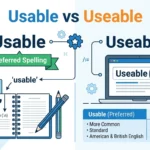
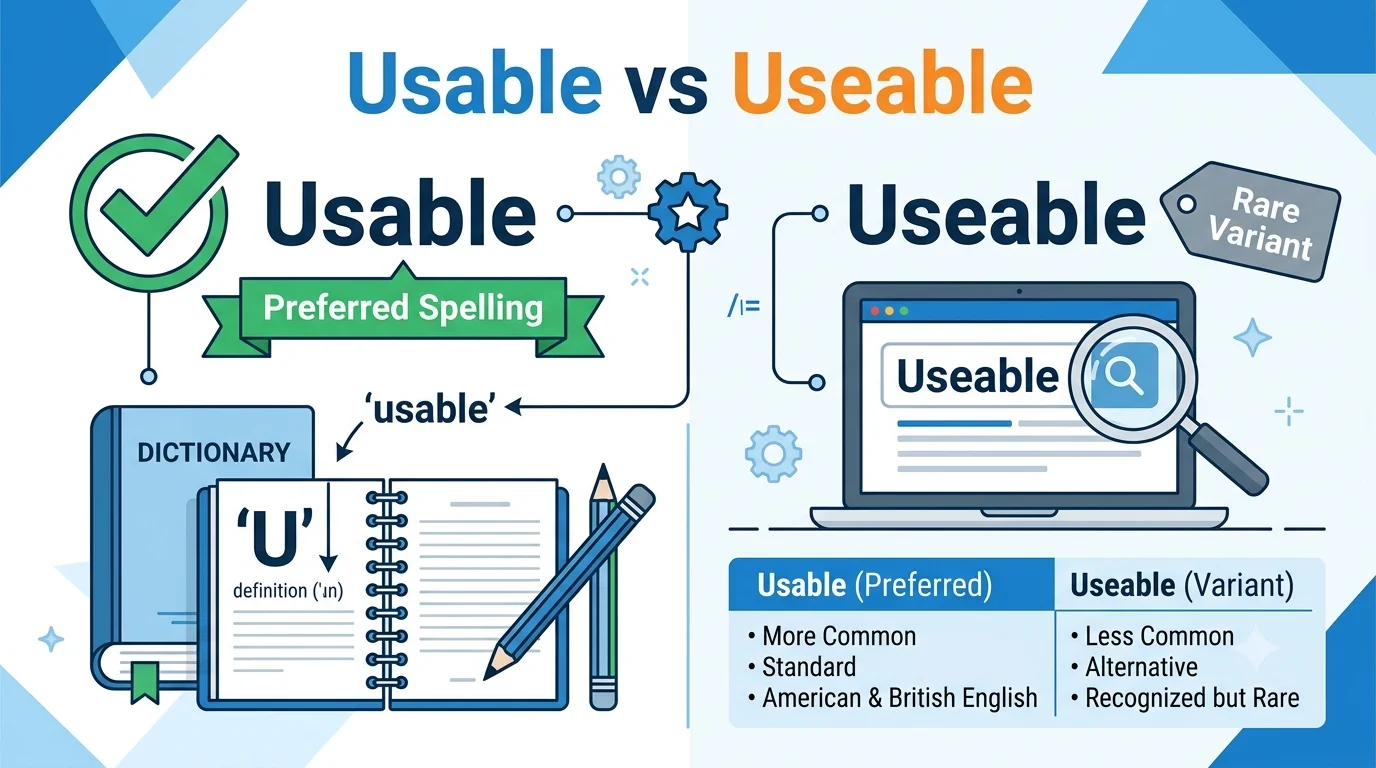
Usable vs Useable
Quick Answer:
Usable is the preferred spelling in modern English. It means able to be used, fit for use, or functional. Useable has the same meaning but is an uncommon variant that most editors and style guides recommend avoiding.
At a Glance
| Question | Answer |
|---|---|
| Correct modern spelling | Usable ✅ |
| Variant spelling | Useable |
| Same meaning? | Yes |
| Preferred in American English | Usable |
| Preferred in British English | Usable |
| Recommended for formal writing | Usable |
| Safe choice for all audiences | Usable |
Quick Examples
✅ This chair is still usable after several years.
✅ The software is now usable on mobile devices.
⚠️ This chair is still useable after several years.
While the last sentence is understandable, most editors would change useable to usable.
How to Pronounce “Usable” and “Useable”
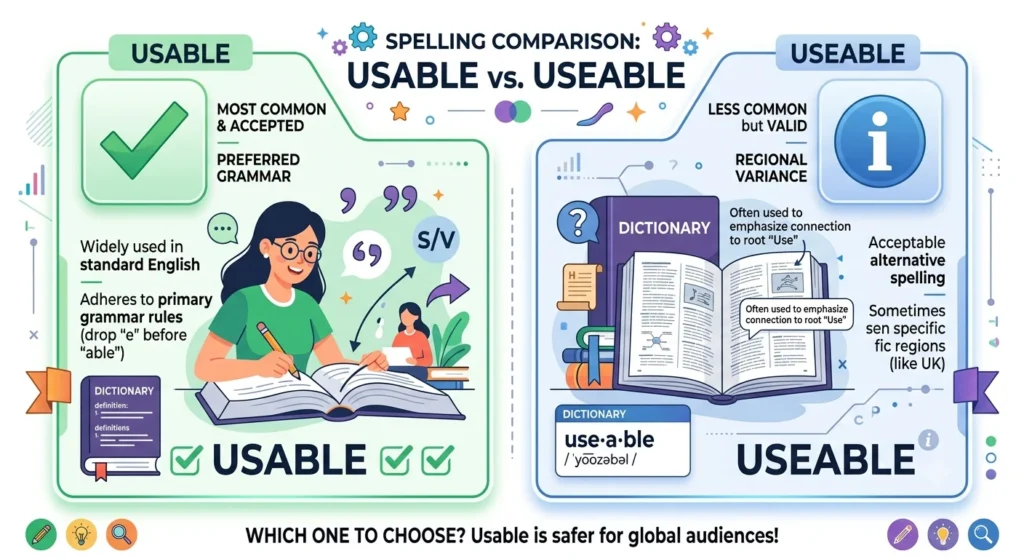
One reason this spelling pair causes confusion is that both words are pronounced exactly the same.
| Word | IPA Pronunciation |
|---|---|
| Usable | /ˈjuːzəbl/ |
| Useable | /ˈjuːzəbl/ |
Because there is no pronunciation difference, readers rely on spelling to decide which form is standard.
What Does “Usable” Mean?
Usable is an adjective that describes something that can be used effectively or is suitable for its intended purpose.
Definition
Usable means:
- Able to be used
- Fit for use
- Functional
- Practical
Examples
- The old laptop is still usable.
- We found several usable chairs in storage.
- The bridge is usable again after repairs.
- This template is simple, clear, and usable.
- The classroom has enough usable space for thirty students.
In each example, usable describes something that is ready or suitable for use.
What Does “Useable” Mean?
The word useable has the same definition as usable.
It also means:
- Able to be used
- Functional
- Practical
- Fit for use
The difference is not the meaning—it is the spelling.
Today, useable appears far less often than usable and is usually treated as a less common variant.
Examples
- The equipment is usable. ✅
- The equipment is useable. ⚠️
Both sentences express the same idea, but the first reflects modern standard English.
Why Do People Write “Useable”?
Many writers naturally assume that the word should be spelled useable because the base verb use ends with the letter e.
It seems logical to think:
use + able = useable
However, English spelling often removes the silent e before adding the suffix -able.
For example:
| Base Word | Correct Adjective |
|---|---|
| use | usable |
| move | movable |
| value | valuable |
| blame | blamable |
Because English spelling has many exceptions, some writers kept the extra e, and the variant useable continued to appear in older books and dictionaries.
Today, however, usable is the standard spelling used in modern English.
Remember: If you’re writing for school, work, publishing, or the web, choose usable.
The Grammar Rule Behind “Usable”
Understanding the spelling rule makes this word much easier to remember.
The suffix -able means “capable of” or “fit for.” When it is added to many verbs ending in a silent e, the e is dropped.
Examples
| Verb | Adjective |
|---|---|
| use | usable |
| value | valuable |
| move | movable |
| excuse | excusable |
This pattern explains why usable is the preferred spelling.
Are There Exceptions?
Yes. English spelling includes exceptions, so not every word follows exactly the same pattern.
For example:
| Word | Correct Form |
|---|---|
| notice | noticeable |
| manage | manageable |
| change | changeable |
Because some words keep the final e while others do not, dictionaries remain the most reliable guide when you’re unsure.
❤️ Cute 4th Of July Rizz Lines to Light Up Your Conversations ✨
Word Forms
Understanding related word forms can help you use the word correctly.
| Part of Speech | Word | Example |
|---|---|---|
| Verb | use | We use this tool every day. |
| Noun | use | The machine has many uses. |
| Adjective | usable | The equipment is usable. |
| Adverb (rare) | usably | The software works usably on older devices. |
The Origin of “Usable”
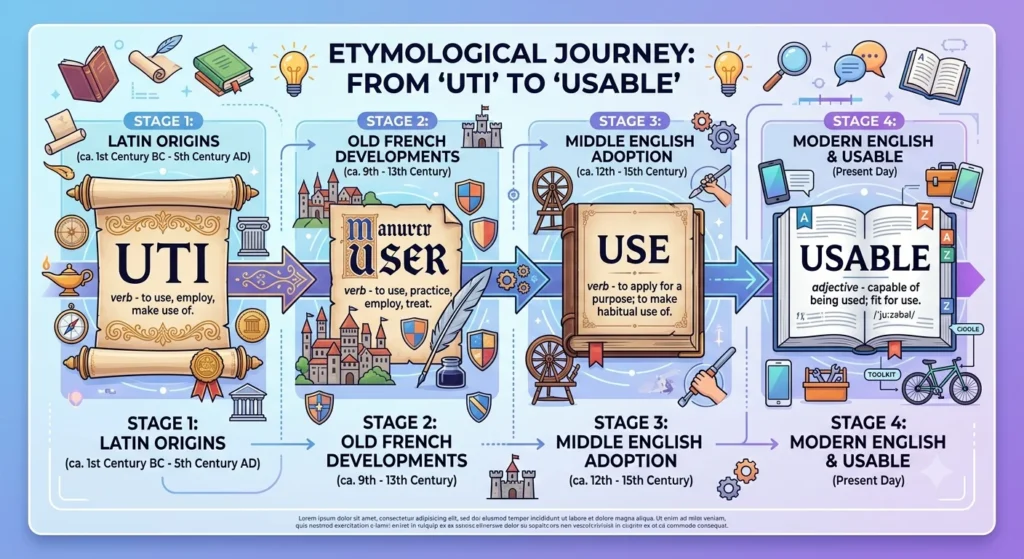
The adjective usable comes from the verb use, which entered English from Old French user. That word traces back to the Latin verb uti, meaning to employ, to make use of, or to benefit from.
As English developed, speakers added the suffix -able to create an adjective meaning “able to be used.”
In earlier centuries, both usable and useable appeared in print. Before spelling became more standardized, different authors often preferred different forms.
Over time, editors, publishers, educators, and dictionary writers gradually adopted usable as the standard spelling because it fits the common English pattern for many -able adjectives. Today, usable appears far more frequently in books, newspapers, academic writing, business communication, and online publications.
A Brief Timeline
| Period | Common Usage |
|---|---|
| Early Modern English | Both usable and useable appear |
| 19th–20th Century | Usable becomes increasingly common |
| Modern English | Usable is the standard spelling |
British English vs American English: Is There a Difference?
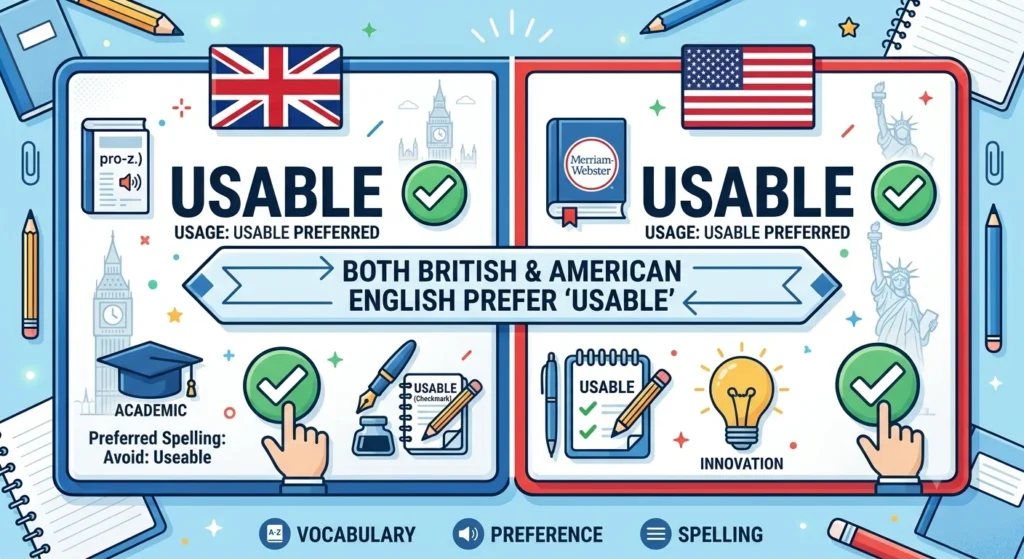
Many people search for “useable or usable UK” because they assume useable is the British spelling and usable is the American spelling.
The answer is simple:
No. Both British English and American English prefer the spelling “usable.”
Unlike spelling pairs such as:
- Colour vs Color
- Recognise vs Recognize
- Organise vs Organize
- Travelling vs Traveling
there is no major regional spelling difference between usable and useable.
Whether you’re writing for readers in the United States, the United Kingdom, Canada, Australia, New Zealand, or other English-speaking countries, usable is the spelling you’ll see most often.
Although useable still appears in some dictionaries as a variant, it is uncommon in modern writing.
British vs American English Comparison
| Feature | American English | British English |
|---|---|---|
| Preferred spelling | Usable ✅ | Usable ✅ |
| Alternative spelling | Useable (rare) | Useable (rare) |
| Academic writing | Usable | Usable |
| Business writing | Usable | Usable |
| Newspapers | Usable | Usable |
| Government documents | Usable | Usable |
Examples
American English
- This software is usable on all devices.
- The old bridge is still usable.
British English
- This software is usable on all devices.
- The old bridge is still usable.
As you can see, both varieties of English use the same preferred spelling.
What Do Major Dictionaries Say?
One of the best ways to settle a spelling question is to see what trusted dictionaries recommend.
The world’s leading dictionaries all recognize usable, and most list useable only as an alternative spelling.
Oxford Dictionary
If you’ve searched “usable vs useable Oxford Dictionary,” here’s the answer.
Oxford lists usable as the main entry and treats useable as a less common variant.
That means Oxford recommends usable for modern writing.
Cambridge Dictionary
Cambridge Dictionary uses usable as the standard spelling in its definitions and examples.
You will rarely see useable because it is uncommon in today’s English.
Merriam-Webster Dictionary
Merriam-Webster follows the same approach.
It lists usable as the preferred spelling while acknowledging useable as an alternative form.
Collins Dictionary
Collins Dictionary also gives preference to usable.
Although useable appears as a recognized variant, Collins recommends usable for everyday writing.
Dictionary Comparison Table
| Dictionary | Preferred Spelling | Accepts “Useable”? | Recommendation |
|---|---|---|---|
| Oxford | Usable ✅ | Yes (variant) | Use usable |
| Cambridge | Usable ✅ | Rarely listed | Use usable |
| Merriam-Webster | Usable ✅ | Yes (variant) | Use usable |
| Collins | Usable ✅ | Yes (variant) | Use usable |
Why Dictionary Recommendations Matter
Professional editors, publishers, teachers, universities, and businesses rely on respected dictionaries because they reflect current standard English rather than outdated or uncommon spellings.
When multiple trusted dictionaries agree, it’s a strong sign that usable is the spelling you should choose.
Which Spelling Should You Use?
For almost every writing situation, usable is the correct choice.
Whether you’re writing for school, work, or the internet, usable is the spelling readers expect.
Use Usable For:
- School assignments
- College essays
- Business emails
- Research papers
- Blog posts
- Website content
- Marketing copy
- Technical documentation
- News articles
- Professional reports
- Social media posts
When Might You See “Useable”?
Although uncommon, you may still encounter useable in:
- Older books
- Historical documents
- Archived newspapers
- Older dictionaries
- Direct quotations
If you’re quoting an older source, keep the original spelling. Otherwise, choose usable.
Audience Guide
| Audience | Recommended Spelling |
|---|---|
| Students | Usable |
| Teachers | Usable |
| Bloggers | Usable |
| Businesses | Usable |
| Publishers | Usable |
| International readers | Usable |
Professional Writing Tip
If you want your writing to look modern, polished, and consistent, always use usable.
Why Does Spell Check Accept Both?
Many people are surprised when their spell checker doesn’t flag useable as incorrect.
The reason is simple.
Some spell-check tools include variant spellings found in respected dictionaries. Since useable appears as an accepted variant in a few dictionaries, software may allow it even though it is much less common.
This doesn’t mean both spellings are equally recommended.
Professional editors and most style guides still prefer usable because it is the standard form in contemporary English.
Remember
- ✔ Accepted by some spell checkers: Useable
- ✔ Preferred by editors and style guides: Usable
When writing for school, work, publishing, or online audiences, usable is the safer choice.
Common Mistakes with Usable vs Useable
Understanding common mistakes helps you avoid them in your own writing.
Mistake 1: Thinking “Useable” Is the Correct Spelling
❌ The instructions are useable.
✅ The instructions are usable.
Although useable exists, usable is the preferred spelling.
Mistake 2: Believing Britain Uses “Useable”
Many learners assume:
- America → usable
- Britain → useable
This is incorrect.
Both American and British English prefer usable.
Mistake 3: Keeping the Silent “E”
Some writers think the word should keep the e because the verb is use.
However, many adjectives ending in -able drop the silent e.
Examples:
| Verb | Correct Adjective |
|---|---|
| Use | Usable |
| Value | Valuable |
| Move | Movable |
| Excuse | Excusable |
Mistake 4: Using “Useable” in Professional Writing
Although dictionaries recognize useable, it may look outdated in:
- Business reports
- Academic essays
- Website articles
- Research papers
- Professional emails
Editors generally replace it with usable.
Mistake 5: Assuming Both Spellings Are Equally Common
They are not.
Today, usable appears much more frequently in books, newspapers, educational materials, and online publications.
Usable in a Sentence
Here are some examples showing the preferred spelling in everyday English.
- The laptop is still usable after several years.
- We need usable information before making a decision.
- The road became usable after the storm.
- The software has a clean and usable interface.
- The classroom contains usable furniture.
- Please upload a usable copy of the document.
- The kitchen is old but still usable.
- These tools remain usable despite their age.
- The office now has more usable space.
- The design is attractive and usable.
Useable in a Sentence
You may occasionally see useable in older writing or quotations.
Examples include:
- The equipment is useable, although it needs cleaning.
- The building remained useable after repairs.
These sentences are understandable, but in modern writing, most editors would change useable to usable.
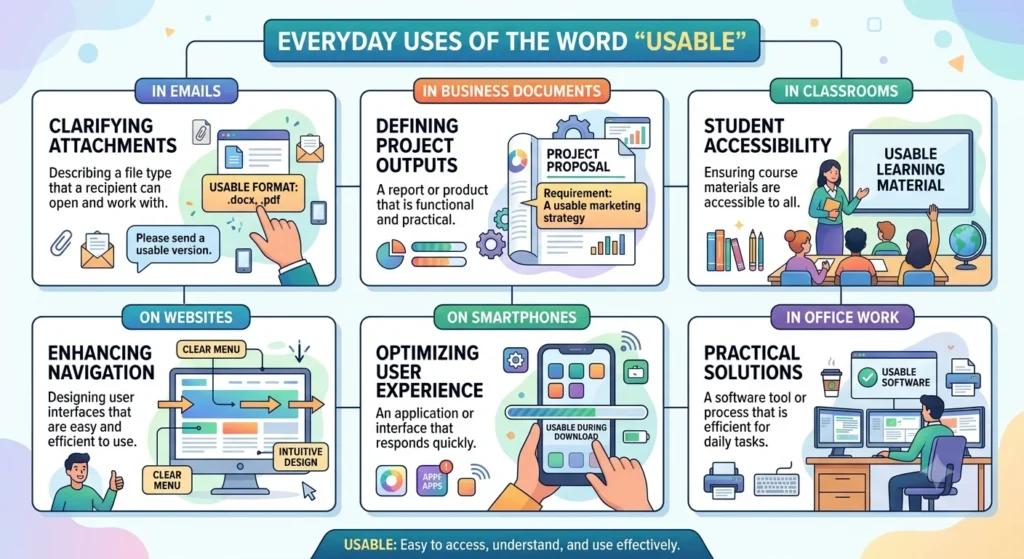
Usable vs Useable in Everyday Examples
Seeing the word in different situations makes it easier to remember.
In Emails
- Is this file still usable?
- Please send a usable version of the report.
- The download link is now usable.
In Business
- We need a more usable website.
- The software offers a usable interface.
- This process is simple and usable for new employees.
In Education
- Students need usable learning materials.
- The teacher prepared a usable study guide.
- The science lab contains usable equipment.
In Technology
- The latest update made the app more usable.
- The website is fully usable on mobile devices.
- The menu is easy to navigate and highly usable.
In News
- Officials confirmed the bridge is usable again.
- The airport runway is now usable.
- Emergency crews restored usable roads overnight.
On Social Media
- Finally! The app is actually usable now.
- My old phone is still usable.
- This template is simple, clean, and usable.
Common Collocations with “Usable”
Native speakers often use usable with certain nouns.
Examples include:
- usable data
- usable information
- usable software
- usable interface
- usable website
- usable design
- usable space
- usable materials
- usable equipment
- usable product
- usable tools
- usable condition
- usable solution
- usable resources
- usable document
Learning these common combinations will help your writing sound more natural and fluent.
Usable vs Useable: Usage Trends
Many people search for usable vs useable because they see both spellings online and want to know which one is correct. Although both forms have existed for many years, their popularity is very different today.
In modern English, usable is overwhelmingly the preferred spelling. It appears far more often in books, newspapers, academic journals, business documents, government publications, and websites. The spelling useable still appears occasionally, but it is much less common and is usually found in older publications or as a recognized variant in some dictionaries.
If your goal is clear, professional writing, usable is the better choice.
General Usage by Region
| Country | Most Common Spelling |
|---|---|
| United States | Usable ✅ |
| United Kingdom | Usable ✅ |
| Canada | Usable ✅ |
| Australia | Usable ✅ |
| New Zealand | Usable ✅ |
| India | Usable ✅ |
Usage Frequency
| Spelling | Modern Usage | Recommendation |
|---|---|---|
| Usable | Very common | ✅ Use in all writing |
| Useable | Rare | ⚠ Use only when quoting older sources |
Why Is “Usable” More Common?
There are several reasons why usable has become the standard spelling:
- It follows modern English spelling conventions.
- It is the preferred form in leading dictionaries.
- It is widely used by publishers and editors.
- It appears more often in educational and professional writing.
- Most readers recognize it as the standard spelling.
Usable vs Useable Comparison Table
| Feature | Usable | Useable |
|---|---|---|
| Meaning | Able to be used | Able to be used |
| Pronunciation | Same | Same |
| Correct spelling | ✅ Standard | ✅ Variant |
| Modern English | Preferred | Rare |
| American English | Preferred | Rare |
| British English | Preferred | Rare |
| Academic writing | Recommended | Usually avoided |
| Business writing | Recommended | Usually avoided |
| Professional writing | Recommended | Usually avoided |
| Dictionary status | Main entry | Variant in some dictionaries |
Word Forms
Understanding related forms helps you use the word correctly.
| Part of Speech | Word | Example |
|---|---|---|
| Verb | Use | We use this software every day. |
| Noun | Use | The tool has many uses. |
| Adjective | Usable | The equipment is usable. |
| Adverb (rare) | Usably | The system performs usably on older devices. |
Synonyms of “Usable”
If you want to avoid repeating usable, these alternatives may fit depending on the context.
| Synonym | Best Use |
|---|---|
| Functional | Something works correctly |
| Practical | Useful in everyday situations |
| Serviceable | Still works even if old |
| Operable | Machines and equipment |
| Effective | Produces the desired result |
| Useful | Helpful or beneficial |
| Working | Operating properly |
| Fit for use | Formal writing |
| Ready to use | Products and tools |
| Reliable | Dependable over time |
Examples
- The old printer is still functional.
- We need a practical solution.
- The equipment remains serviceable.
- The machine is fully operable.
- The report contains useful information.
Key Takeaways
Before you finish, remember these important points:
- Usable is the standard spelling in modern English.
- Useable is a recognized but uncommon variant.
- Both words have the same meaning and pronunciation.
- British and American English both prefer usable.
- Major dictionaries list usable as the main spelling.
- Usable is the best choice for school, work, publishing, and online writing.
- When in doubt, choose usable.
Frequently Asked Questions
1. Is it spelled useable or usable?
The preferred spelling is usable. While useable is recognized by some dictionaries, usable is the standard form used in modern English.
2. What does “usable” mean?
Usable means able to be used, functional, or fit for its intended purpose.
Example:
The old desk is still usable.
3. What does “useable” mean?
Useable has the same meaning as usable. The only difference is that it is a much less common spelling.
4. Is usable an adjective?
Yes. Usable is an adjective because it describes a noun.
Example:
The software is usable.
5. Is useable incorrect?
Not completely. It is an accepted variant in some dictionaries, but it is rarely used today. For modern writing, usable is recommended.
6. Is usable correct in British English?
Yes. Both British English and American English prefer usable.
7. Why is usable spelled without the “e”?
English often drops the silent e before adding the suffix -able, which is why use becomes usable.
8. Does the Oxford Dictionary accept useable?
Yes. Oxford recognizes useable as a variant spelling, but usable is the preferred headword.
9. Which spelling should I use in formal writing?
Always use usable in academic, business, and professional writing.
10. Why do some spell checkers accept “useable”?
Some spell checkers include variant spellings listed in dictionaries. However, acceptance by software does not mean it is the preferred modern spelling.
Conclusion
The debate over usable vs useable is simpler than it first appears. Both spellings have existed in English for many years and share the same meaning and pronunciation. However, modern English has clearly settled on usable as the preferred and standard spelling.
Leading dictionaries, educators, editors, publishers, and style guides consistently recommend usable for academic, professional, business, and everyday writing. Although useable remains a recognized variant in some dictionaries, it is uncommon and may look outdated to many readers.
A useful way to remember the difference is that many adjectives ending in -able drop the silent e from the base word. While English has exceptions, usable follows the spelling that has become standard in contemporary English.
Whenever you are unsure which spelling to choose, ask yourself one simple question: Which form will look the clearest and most professional to my readers? In almost every situation, the answer is usable.
By choosing usable, you align your writing with modern dictionary recommendations, improve consistency, and communicate more confidently with readers around the world.