Have you ever stopped while writing and wondered whether the correct word is effective or affective? You’re not alone. These two English words look almost identical and sound very similar, making them one of the most commonly confused word pairs. However, they have completely different meanings, and choosing the wrong one can change the meaning of your sentence.
Many people search questions like “What is the difference between affective and effective?”, “Is it affective or effective immediately?”, “What does affective mean?”, and “Effective vs affective pronunciation.” This guide answers all of those questions with simple explanations, real-life examples, comparison tables, and expert writing tips.
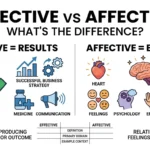
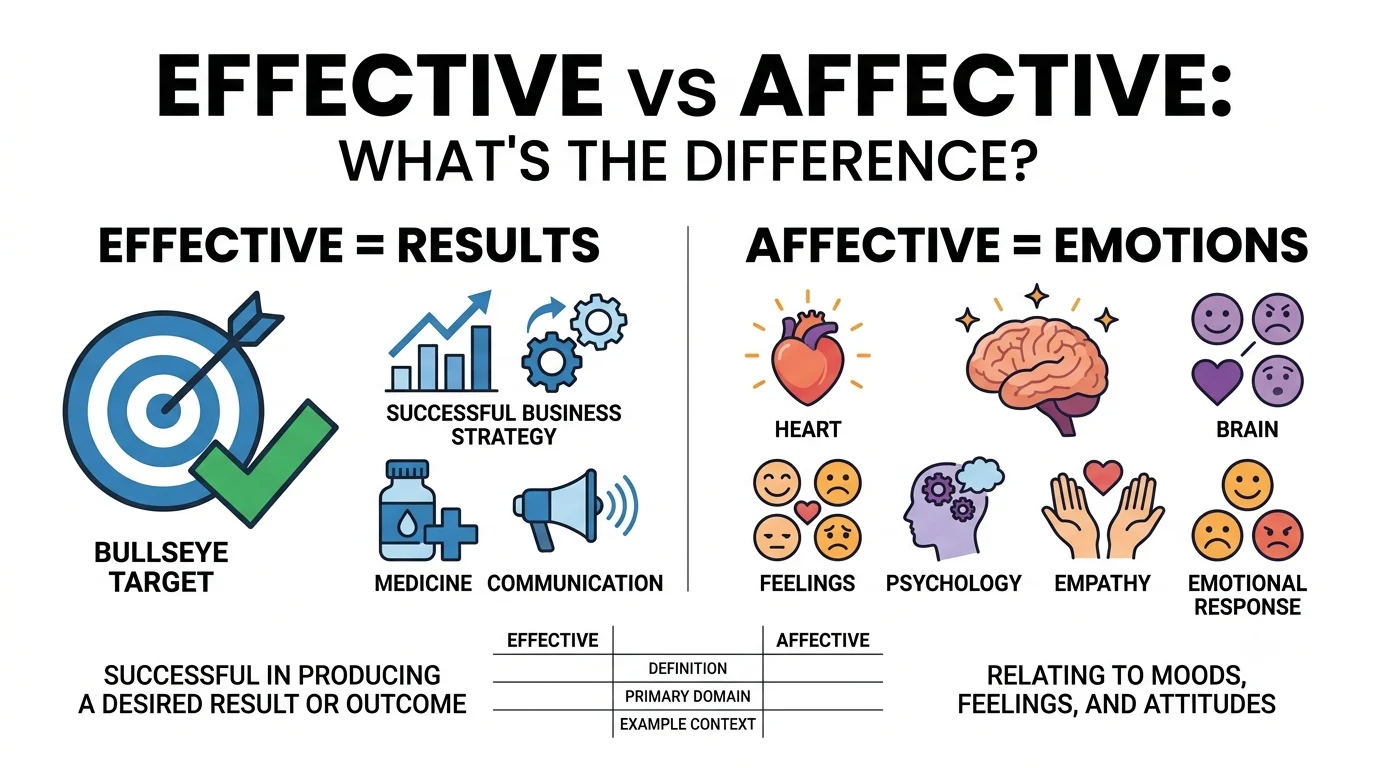
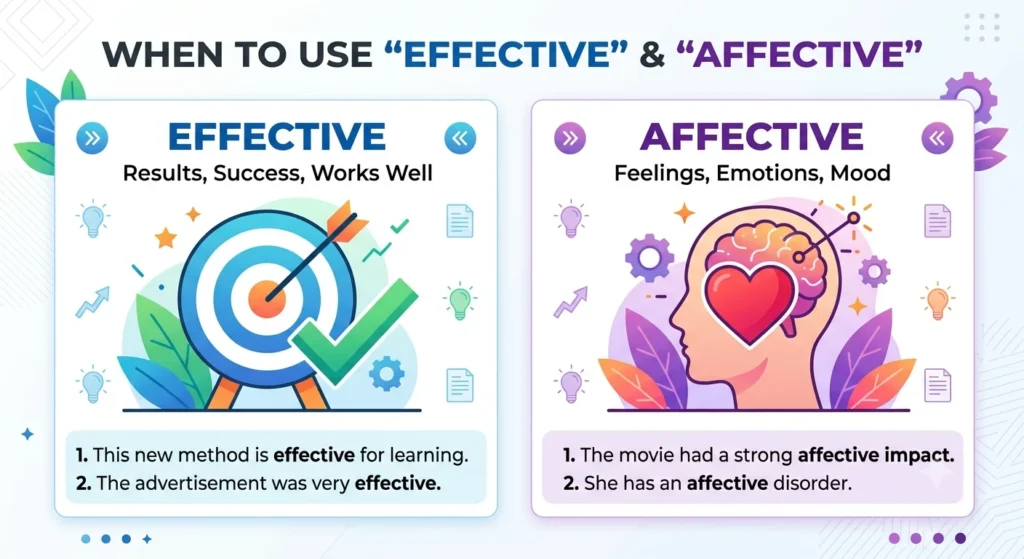
The basic rule is easy to remember. Effective means something works well or produces the desired result. Affective relates to emotions, feelings, or moods and is mainly used in psychology, education, counseling, and healthcare.
Whether you’re a student, teacher, writer, business professional, or English learner, this guide will help you use effective and affective correctly in every situation. By the end, you’ll know the meanings, pronunciation, origins, common mistakes, and practical usage of both words with confidence.
Key Takeaways
Need the quick answer? Here are the most important points.
- Effective = Produces the desired result or works successfully.
- Affective = Relates to emotions, feelings, or moods.
- Effective immediately is always the correct phrase.
- Affective is commonly used in psychology, education, and mental health.
- Remember: Effect = Result, Affect = Emotion.
Effective vs Affective
What Is the Difference Between Effective and Affective?
Effective means successful, working well, or producing the intended result.
Affective means related to emotions, feelings, moods, or emotional responses.
Although these words share similar spelling and pronunciation, they are not interchangeable.
Effective describes something that produces the desired result or works successfully, while affective refers to emotions, feelings, or emotional responses. Use effective when talking about results and affective when discussing emotions, especially in psychology and education.
Quick Comparison Table
| Feature | Effective | Affective |
|---|---|---|
| Meaning | Produces the desired result | Related to emotions or feelings |
| Focus | Results and success | Emotions and mood |
| Everyday Use | Very common | Less common |
| Business Writing | Frequently used | Rare |
| Psychology | Occasionally | Very common |
| Education | Common | Common in emotional learning |
| Example | An effective plan saved time. | Music created an affective response. |
Examples
Effective
- The new medicine is effective.
- Exercise is an effective way to stay healthy.
- Good communication is effective in solving problems.
- The policy becomes effective immediately.
Affective
- The movie had a strong affective impact.
- The therapist studied the patient’s affective responses.
- Emotional intelligence includes affective skills.
- Researchers explored affective psychology.
Easy Memory Trick
One of the easiest ways to remember these words is to connect them with familiar ideas.
Effective → Effect → Result
If something is effective, it creates the effect you wanted.
Think of:
- effective medicine
- effective communication
- effective leadership
- effective teaching
- effective solution
They all produce successful results.
Affective → Affect → Emotion
In psychology, affect refers to emotions or emotional expression.
So affective always relates to:
- feelings
- emotions
- mood
- emotional behavior
Think of:
- affective learning
- affective psychology
- affective communication
- affective disorders
Simple Formula
✅ Effective = Result
❤️ Affective = Emotion
This memory trick helps you choose the correct word in seconds.
Effective vs Affective Pronunciation
Many people confuse these words because they sound almost the same when spoken.
| Word | IPA Pronunciation | Simple Pronunciation |
|---|---|---|
| Effective | /ɪˈfek.tɪv/ | ih-FEK-tiv |
| Affective | /əˈfek.tɪv/ | uh-FEK-tiv |
The difference is only in the first syllable, so it can be difficult to hear in fast speech. That is why these words are often mixed up in writing.
Pronunciation Tip
Say these words slowly:
- Effective → ih-FEK-tiv
- Affective → uh-FEK-tiv
Listening carefully to the first sound will help you recognize the correct word.
The Origin of Effective vs Affective
Learning where these words come from makes their meanings easier to understand and remember.
Origin of Effective
The word effective comes from the Latin word effectivus, which means productive, accomplishing, or bringing about a result. It entered English during the Middle Ages and has consistently been used to describe something that successfully achieves its purpose.
Today, effective is widely used in business, education, healthcare, law, science, marketing, and everyday communication.
Common Examples
- effective treatment
- effective communication
- effective leadership
- effective learning
- effective strategy
- effective management
- effective advertising
Origin of Affective
The word affective comes from the Latin word affectus, meaning emotion, feeling, or state of mind. It became common much later, mainly in psychology, education, neuroscience, counseling, and mental health.
Unlike effective, affective is rarely used in everyday conversation. Instead, it appears most often in academic writing and scientific research.
Common Examples
- affective psychology
- affective learning
- affective neuroscience
- affective behavior
- affective disorders
- affective communication
- affective response
Why Do People Confuse These Words?
There are several reasons why effective and affective are commonly confused:
- They begin with similar letters.
- They both end in -ective.
- Their pronunciation is almost identical.
- Both come from related Latin roots.
- They are adjectives used in formal English.
However, their meanings are completely different.
| Word | Main Idea |
|---|---|
| Effective | Success, results, performance |
| Affective | Feelings, emotions, mood |
Professional Writing Tip
Before choosing a word, ask yourself:
- Am I talking about results? → Use effective.
- Am I talking about emotions? → Use affective.
This simple question prevents one of the most common vocabulary mistakes in English.
British English vs American English Spelling
Unlike words such as colour/color or organise/organize, effective and affective are spelled exactly the same in both British English and American English.
There are no spelling differences between the two varieties of English. The only challenge is selecting the correct word based on its meaning.
Examples
American English
- The vaccine is effective.
- Children develop affective skills through play.
British English
- This method is effective.
- The course includes affective learning objectives.
The spelling remains identical in both versions of English.
British vs American Comparison Table
| Feature | Effective | Affective |
|---|---|---|
| British English | Effective | Affective |
| American English | Effective | Affective |
| Canadian English | Effective | Affective |
| Australian English | Effective | Affective |
| New Zealand English | Effective | Affective |
| Meaning Changes? | ❌ No | ❌ No |
Key Point
No matter where your audience is—whether in the United States, the United Kingdom, Canada, Australia, New Zealand, or elsewhere—the spellings remain:
- ✅ Effective
- ✅ Affective
The only thing that changes is how you use them based on their meanings.
Which Word Should You Use?
Choosing between effective and affective is easy once you know what you are talking about.
Ask yourself one simple question:
Am I talking about results or emotions?
- If you’re talking about results, success, performance, or something that works, use effective.
- If you’re talking about feelings, emotions, mood, or emotional responses, use affective.
This simple rule will help you choose the correct word almost every time.
Use Effective When Talking About Results
Effective describes something that achieves its goal or produces the desired outcome. It is one of the most common adjectives in English and appears in business, education, healthcare, technology, law, and everyday communication.
Common Phrases
- effective communication
- effective leadership
- effective teaching
- effective learning
- effective strategy
- effective management
- effective solution
- effective treatment
- effective medicine
- effective marketing
- effective teamwork
- effective immediately
Examples
- The new vaccine is effective against the disease.
- Good planning leads to effective project management.
- Exercise is an effective way to improve your health.
- The company’s new strategy proved highly effective.
- The updated policy is effective immediately.
Use Affective When Talking About Emotions
Affective refers to emotions, feelings, moods, or emotional responses. It is mainly used in psychology, education, counseling, neuroscience, and mental health.
Common Phrases
- affective psychology
- affective learning
- affective communication
- affective response
- affective behavior
- affective development
- affective neuroscience
- affective disorder
- affective state
Examples
- The therapist evaluated the patient’s affective state.
- Music can create a powerful affective response.
- The study focused on children’s affective development.
- Emotional intelligence includes important affective skills.
- Researchers examined affective communication during counseling sessions.
Affective vs Emotional
Many people also ask:
Is “affective” the same as “emotional”?
Not exactly.
Both words relate to feelings, but they are used in different situations.
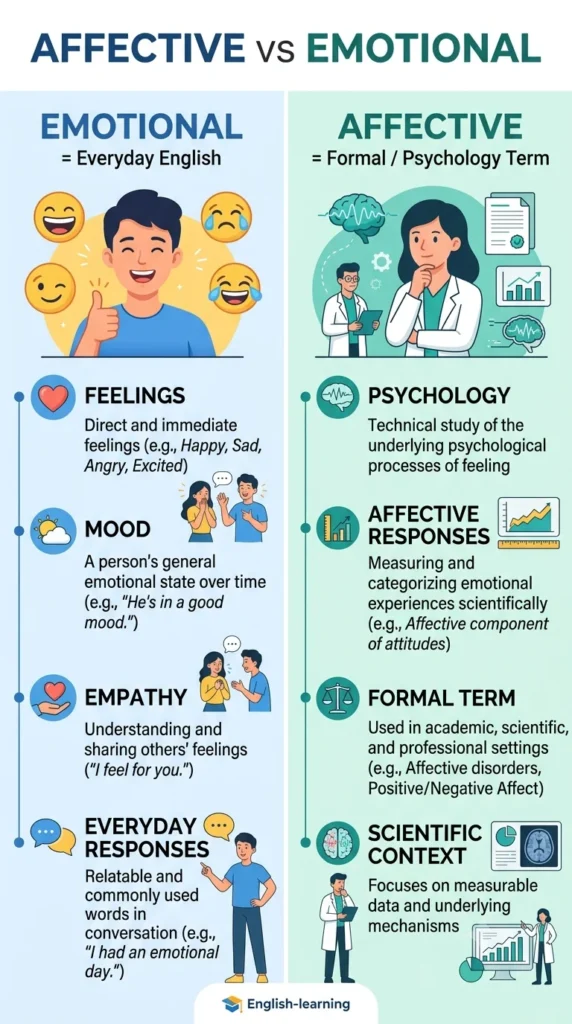
Emotional is the everyday word used in normal conversation.
Affective is the formal, academic term used in psychology, education, counseling, neuroscience, and scientific writing.
Comparison Table
| Emotional | Affective |
|---|---|
| Everyday English | Academic English |
| Common in conversation | Common in psychology |
| Informal | Formal |
| Easy for everyone to understand | Mostly used by professionals |
| Emotional reaction | Affective response |
Examples
Everyday English
- She became very emotional after hearing the news.
- It was an emotional speech.
Academic English
- The experiment measured affective responses.
- The researchers studied affective learning.
Writing Tip
If you’re writing a school essay, research paper, or psychology report, affective is often the better choice.
If you’re writing a blog, email, or social media post, emotional is usually more natural.
Formal vs Informal Usage
Understanding where each word is commonly used helps you sound more natural.
| Situation | Effective | Affective |
|---|---|---|
| Business emails | ✅ Very common | ❌ Rare |
| Job applications | ✅ Common | ❌ Rare |
| School assignments | ✅ Common | ✅ Sometimes |
| Psychology research | ✅ Sometimes | ✅ Very common |
| Medical writing | ✅ Common | ✅ Common |
| Daily conversations | ✅ Very common | ❌ Rare |
| Social media | ✅ Common | Rare unless discussing psychology |
Professional Advice
If you’re unsure which word to use in professional writing, effective is usually the correct choice unless the topic specifically involves emotions or psychology.
Synonyms and Antonyms
Using related words improves your vocabulary and helps search engines understand your content.
Effective Synonyms
- successful
- useful
- productive
- efficient
- practical
- powerful
- beneficial
- capable
- reliable
- impactful
Effective Antonyms
- ineffective
- unsuccessful
- useless
- weak
- powerless
- inefficient
Affective Synonyms
- emotional
- feeling-based
- psychological
- mood-related
- expressive
- empathetic
- sentimental
- emotion-focused
Affective Antonyms
- unemotional
- detached
- emotionless
- indifferent
- impersonal
Common Mistakes with Effective vs Affective
Although these words look similar, they cannot replace each other. Here are some of the most common mistakes and how to fix them.
Mistake #1: Using Affective Instead of Effective
❌ The new software is affective for small businesses.
✅ The new software is effective for small businesses.
Why?
Software is judged by how well it works, not by emotions.
Mistake #2: Using Effective Instead of Affective
❌ The psychologist studied children’s effective development.
✅ The psychologist studied children’s affective development.
Why?
The discussion is about emotional development.
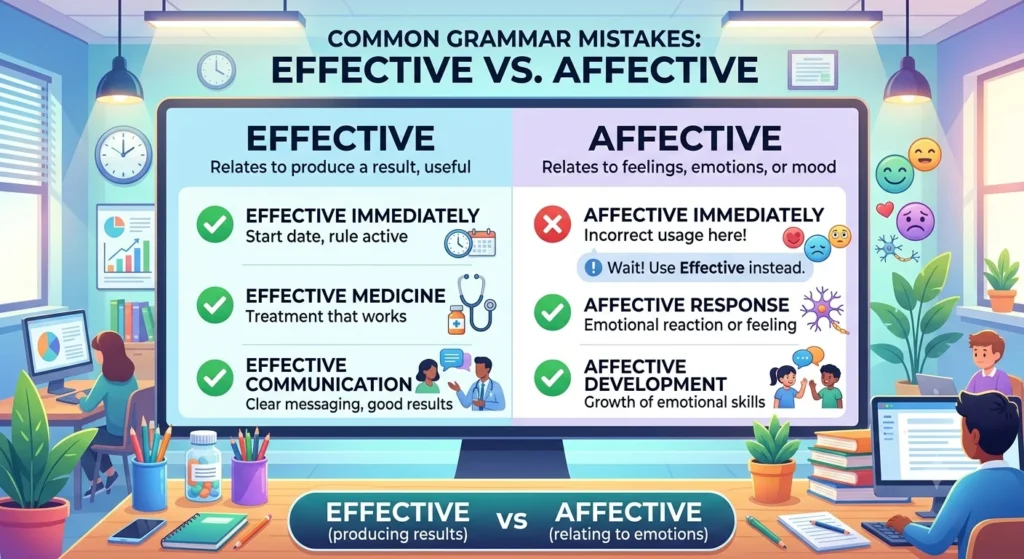
Mistake #3: “Effective Immediately” vs “Affective Immediately”
One of the most searched questions is:
Is it affective or effective immediately?
The answer is simple.
✅ Effective immediately
❌ Affective immediately
The phrase effective immediately means something begins at once.
Examples:
- The new policy is effective immediately.
- The law becomes effective immediately.
- Your resignation is effective immediately.
The phrase affective immediately is always incorrect because affective relates to emotions, not timing or legal effect.
Mistake #4: Thinking They Mean the Same Thing
They never have the same meaning.
| Incorrect | Correct |
|---|---|
| affective medicine | effective medicine |
| affective solution | effective solution |
| effective emotions | affective emotions |
| effective response (psychology) | affective response |
When NOT to Use Each Word
Knowing when not to use these words is just as important.
Do NOT Use Effective
❌ She gave an effective emotional response.
✅ She gave an affective response.
Do NOT Use Affective
❌ This medicine is affective.
✅ This medicine is effective.
More Examples
❌ affective leadership
✅ effective leadership
❌ affective communication strategy
✅ effective communication strategy
❌ effective disorder
✅ affective disorder
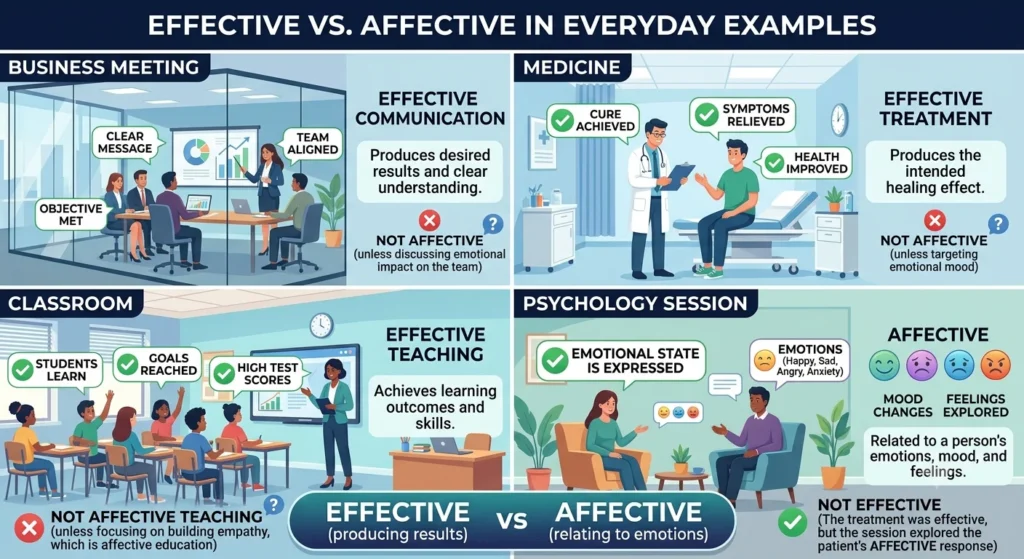
Effective vs Affective in Everyday Examples
Real-life examples make these words easier to remember.
In Emails
Effective
Our new workflow has been very effective.
Affective
The training examined employees’ affective responses to workplace stress.
In Business
- Effective leadership improves teamwork.
- Effective communication builds trust.
- Effective planning saves time.
- Effective marketing increases sales.
In Healthcare
- The treatment proved effective after two weeks.
- Doctors assessed the patient’s affective symptoms during counseling.
In Education
- Teachers use effective teaching strategies.
- Schools also encourage students’ affective development through teamwork and empathy.
In Psychology
- The therapist observed the client’s affective state.
- Researchers studied affective behavior in children.
- Emotional regulation is an important part of affective development.
On Social Media
Effective
This study method is really effective!
Affective
That movie had such an affective impact—it stayed with me for days.
In News Reports
- Scientists confirmed the vaccine remains effective.
- Researchers published new findings on affective disorders.
Effective vs Affective – Google Trends & Usage Data
The search intent behind effective vs affective is mostly educational. People want a quick definition, but they also want examples that show when each word belongs in a sentence.
Effective has much broader everyday use because people use it when discussing work, medicine, communication, education, business, policies, products, and solutions. Affective has a narrower meaning and appears more often in psychology, education, neuroscience, counseling, and academic writing.
Common Search Questions
People commonly look for answers to questions such as:
- What is the difference between affective and effective?
- What does affective mean?
- What is the effective meaning?
- Is it affective or effective immediately?
- What are affective vs effective examples?
- Is affective the same as emotional?
- What is effective vs affective communication?
- What is effective vs affective psychology?
- How are effective and affective pronounced?
- How do you use affective in a sentence?
Search Intent by Context
| Search Context | More Likely Word |
|---|---|
| Business | Effective |
| Medicine | Effective |
| Communication | Effective |
| Education | Both |
| Psychology | Affective |
| Emotional behavior | Affective |
| Government policies | Effective |
| Workplace performance | Effective |
| Mental health | Affective |
| Academic research | Both |
Important: Search-volume patterns can change over time. Rather than claiming exact Google Trends numbers without a current Trends comparison, it is safer to describe the broad usage pattern: effective is a high-frequency general-English word, while affective is more specialized.
Effective vs Affective Examples
The fastest way to master these words is to compare them in complete sentences.
| Sentence | Correct Word | Why? |
|---|---|---|
| The treatment was highly ___ . | effective | It produced a result. |
| The child showed an ___ response. | affective | It involved emotion. |
| The new policy is ___ immediately. | effective | It takes effect now. |
| The researcher measured ___ behavior. | affective | The behavior involved emotions. |
| She is an ___ communicator. | effective | She communicates successfully. |
| The music produced a strong ___ response. | affective | It produced an emotional response. |
| We need an ___ solution. | effective | The solution should work. |
| The study examined ___ development. | affective | It examined emotional development. |
Effective vs Affective Communication
Both terms can appear with communication, but they highlight different ideas.
Effective Communication
Effective communication means communication that successfully delivers a message, creates understanding, or achieves a goal.
Examples:
- Clear emails are part of effective communication.
- Good listening improves effective communication.
- Managers need effective communication skills.
- Simple language can make workplace communication more effective.
Affective Communication
Affective communication focuses on emotions and emotional expression during communication.
It can involve:
- empathy
- emotional expression
- feelings
- mood
- interpersonal connection
- emotional responses
For example:
The study examined how affective communication influences relationships.
The Difference
Effective communication = communication that works well.
Affective communication = communication involving emotions.
A person can use both at the same time. For example, a good counselor needs communication that is effective while also responding appropriately to a client’s affective needs.
Effective vs Affective Psychology
The distinction becomes especially important in psychology.
Affective Psychology
Affective psychology is concerned with emotions, feelings, moods, and emotional processes.
You may encounter terms such as:
- affective behavior
- affective response
- affective state
- affective development
- affective neuroscience
- affective disorders
- affective processing
Effective in Psychology
Effective still has its normal meaning in psychology.
For example:
Cognitive behavioral therapy can be an effective treatment for some conditions.
Here, effective means the treatment works or produces a desired outcome.
So a psychology article may correctly use both words:
The researchers examined affective responses to determine whether the intervention was effective.
This is an excellent example of the difference:
Affective = what people feel.
Effective = whether something works.
Affective in a Sentence
Here are several natural examples of affective in a sentence:
- The researcher measured the participant’s affective response.
- Music can have a powerful affective effect on listeners.
- The teacher considered students’ affective development.
- The study examined affective behavior during social interactions.
- The psychologist evaluated the patient’s affective state.
- Emotional intelligence involves important affective skills.
- The program supports children’s social and affective development.
Important Usage Note
Affective is grammatically correct in these sentences, but it can sound formal. In everyday English, emotional is often more natural.
For example:
The movie had an emotional impact.
is more natural in casual writing than:
The movie had an affective impact.
Frequently Asked Questions
What is the difference between affective and effective?
Effective means successful or capable of producing the intended result. Affective means related to emotions, feelings, moods, or emotional responses.
Example:
The treatment was effective.
The patient showed an affective response.
Is it affective or effective immediately?
The correct phrase is effective immediately.
It means something starts, applies, or takes effect at once.
The new rule is effective immediately.
Affective immediately is incorrect.
What does “affective” mean?
Affective means related to emotions, feelings, moods, or emotional responses. It is especially common in psychology, education, neuroscience, and other academic fields.
What are examples of affective meaning?
Common examples include:
- affective response — an emotional response
- affective behavior — behavior related to feelings
- affective development — development involving emotions
- affective learning — learning involving attitudes, values, and feelings
- affective state — a person’s emotional condition
Is affective the same as emotional?
They are closely related, but they are not always interchangeable.
Emotional is common in everyday English, while affective is more technical and is frequently used in psychology and academic writing.
What is the effective meaning?
Effective means successful, useful, or capable of producing the intended result.
For example:
This is an effective way to learn new vocabulary.
The method produces a useful result.
How do you pronounce effective and affective?
Effective is commonly pronounced /ɪˈfek.tɪv/, while affective is commonly pronounced /əˈfek.tɪv/.
They sound very similar, which is one reason people confuse them.
What is an easy way to remember effective vs affective?
Use this simple rule:
Effective = Effect = Result
Affective = Affect = Emotion
If you’re talking about whether something works, choose effective. If you’re talking about feelings or emotions, choose affective.
Quick Practice Quiz
Test yourself before finishing the article.
1. The new strategy was highly ___.
A. affective
B. effective
Answer: B — effective
The strategy produced a successful result.
2. The psychologist studied the patient’s ___ response.
A. effective
B. affective
Answer: B — affective
The response involved emotions.
3. The new regulations are ___ immediately.
A. effective
B. affective
Answer: A — effective
The regulations take effect immediately.
4. Music can produce a strong ___ response.
A. effective
B. affective
Answer: B — affective
The response concerns emotions.
Professional Writing Tips
If you are writing an email, essay, article, report, or academic paper, don’t choose the word simply because it sounds right.
Instead, identify the meaning first.
Choose Effective for:
- results
- success
- solutions
- performance
- treatment
- strategies
- policies
- communication
- methods
- actions
Choose Affective for:
- emotions
- feelings
- moods
- emotional responses
- emotional development
- psychology
- counseling
- affective learning
One-Second Test
Ask:
“Does it work?”
→ Effective
“Does it involve feelings?”
→ Affective
This test is especially useful for English learners because it focuses on meaning rather than pronunciation.
Conclusion
The difference between effective and affective is simple once you focus on meaning rather than spelling or pronunciation. Effective means successful, useful, or capable of producing the desired result. It is common in everyday English and appears frequently in business, education, healthcare, communication, government, and professional writing. Affective, on the other hand, relates to emotions, feelings, moods, and emotional responses. It is especially common in psychology, education, counseling, neuroscience, and academic writing.
Remember the easiest rule: effective = result, while affective = emotion. That rule also explains why we say “effective immediately” when a rule or policy starts at once. We use affective when discussing an emotional response or state.
If you are still unsure, replace the word with successful or emotional. If successful makes sense, choose effective. If emotional makes sense, affective may be the right choice. With this simple test and the examples in this guide, you can use both words accurately in casual, professional, and academic English.